
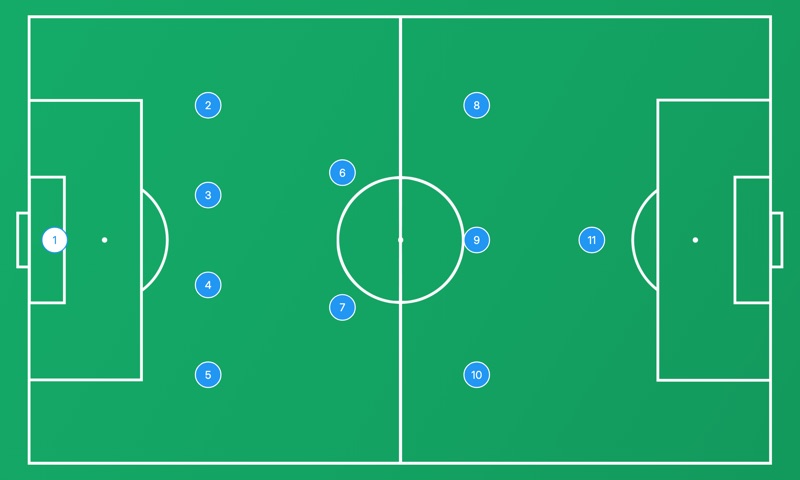
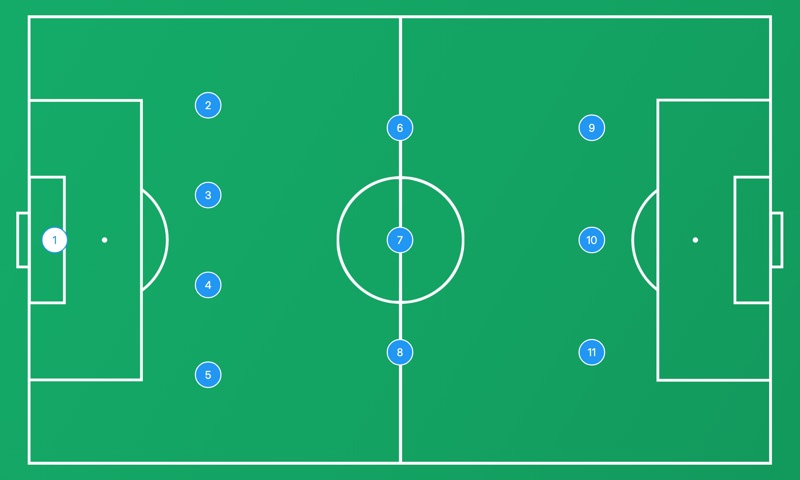
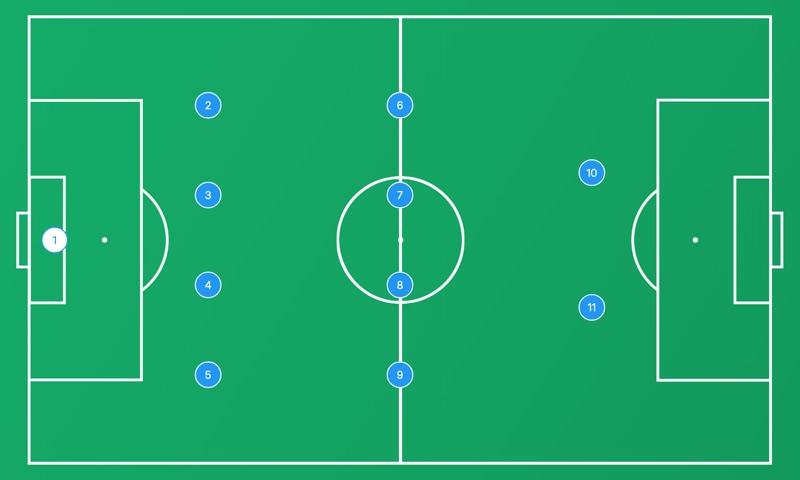
11v11 formations at a glance
The numbers read from the back and leave out the goalkeeper: a 4-3-3 has four defenders, three midfielders and three forwards. These are the shapes you see most often, from youth soccer to the first team.
| Formation | Shape | Pick it when |
|---|---|---|
| 4-4-2 | Four defenders, four midfielders in a line, two strikers | You want two compact banks of four that are easy to teach and two forwards who help each other. |
| 4-3-3 | Four defenders, three midfielders, two wingers and a center forward | You want to keep the ball, stretch the pitch with wingers and press high. |
| 4-2-3-1 | Four defenders, two holding midfielders, three attacking midfielders, one striker | You want cover in front of the back four and plenty of players between the lines. |
| 3-5-2 | Three center backs, five midfielders with wing backs, two strikers | Your wing backs can run the whole flank and you want an extra player in midfield. |
| 4-1-4-1 | Four defenders, a holding midfielder, four midfielders, one striker | You want to defend narrow with two lines of five and break forward. |
| 3-4-3 | Three defenders, four midfielders, three forwards | You want to attack with many players and your defenders can handle one against one. |
The board also has the diamond 4-4-2, the 4-4-1-1, the 4-5-1 and the back-three variants: choose Formations, put eleven players on the pitch and try them.
4-4-2, 4-3-3 or 4-2-3-1?
All three start from a back four; what changes is how the midfield is filled.
- The 4-4-2 is the easiest to explain: two lines of four that shift together and two strikers who share the work. In the middle there are only two central midfielders, though, and against a midfield three they are outnumbered.
- The 4-3-3 uses three midfielders and two wide wingers. It gives lots of passing lanes and width, but asks the wingers to track back and the midfielders to cover the flanks when the ball is lost.
- The 4-2-3-1 protects the defense with two holding midfielders and puts three players between the lines behind the striker. It is the most balanced of the three, but the striker is often alone and must be able to hold the ball up.
A simple rule: if you lose the battles in midfield, move to three central midfielders; if your striker is isolated, bring an attacking midfielder or a second striker closer to him.
A formation changes during the game
The formation on the line-up sheet is the starting position. In possession a 4-3-3 often becomes a 2-3-5 with the full backs high, and out of possession a 4-5-1 with the wingers dropping back; the 4-2-3-1 defends as a 4-4-2 when the number 10 steps up next to the striker. That is why every formation page shows the phases of play: how the team lines up building from the back, in attack and in defense.
From 7v7 and 9v9 to 11v11
Most youth programs move from 7v7 to 9v9 and then to the full 11-a-side game. A good small-sided formation already contains the next one: the 2-3-1 of 7v7 grows into the 4-3-3, the 2-1-2-1 diamond into the diamond 4-4-2. The formations of the smaller format are on the 7v7 formations page.
To get your line-up ready, type the names in the formation builder, or open the tactics board and choose Formations.