
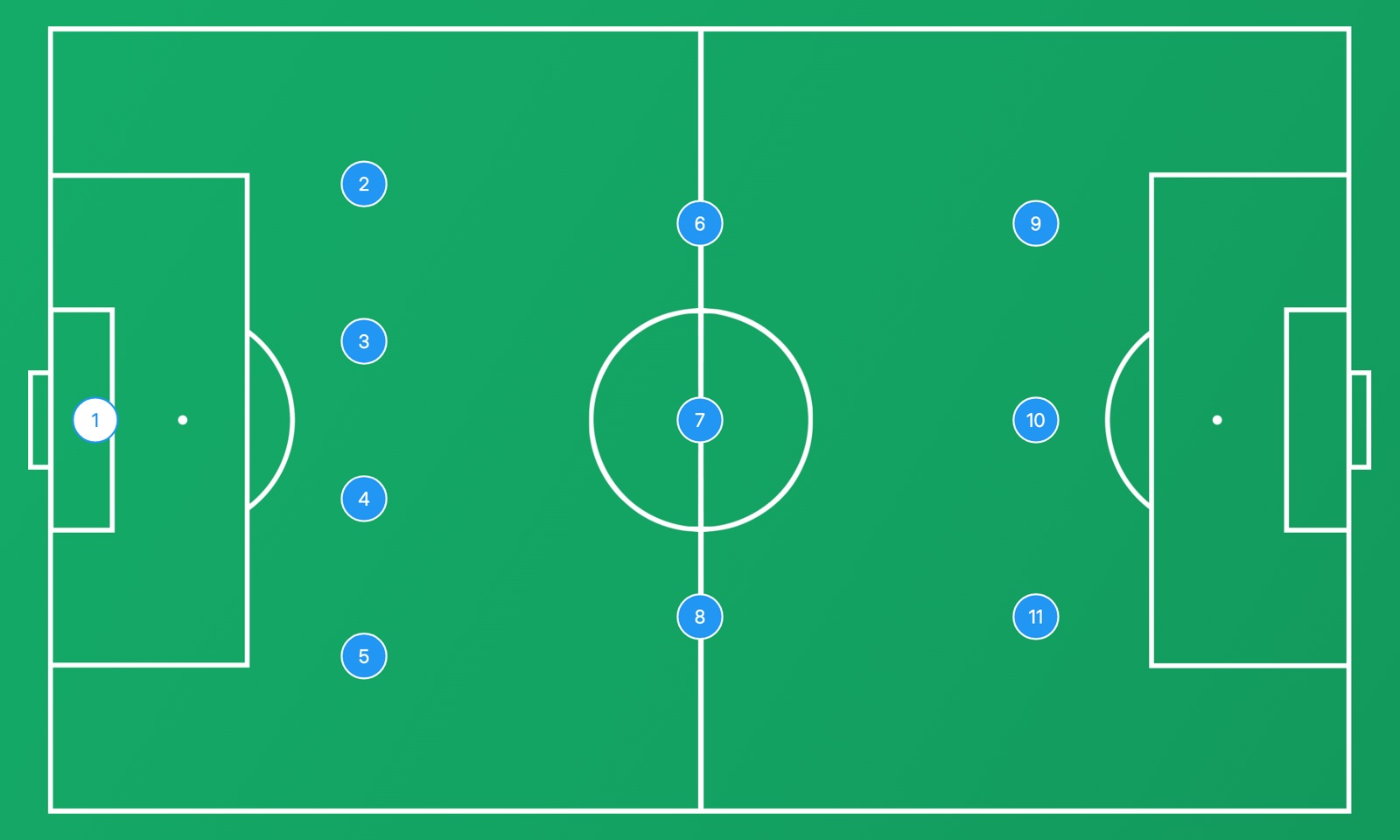
How the 4-3-3 lines up
At the back there is a flat four: two centre-backs and two full-backs. In midfield three central players share the width of the pitch: usually one holding midfielder, the 6, sits in front of the defence, while two more advanced midfielders, the 8s, link the play and arrive in the box. Up front a centre-forward is flanked by two wingers who start wide.
On the board above the three midfielders start in a line. Drop the 6 a few metres towards the defence and push the two 8s forward, and you get the most common version, which some coaches write as 4-1-2-3.
Strengths of the 4-3-3
- Triangles everywhere. Full-back, 8 and winger form a triangle on each flank, and the three midfielders form one in the middle: the player on the ball always has two passing options.
- Control of the centre. Against a two-man midfield, like the one of a 4-4-2, the three central midfielders have a spare player.
- A high press. Three forwards can press the opposing back line straight away and force long balls.
- Width without losing the centre. The wingers stretch the defence and open space between the lines for the 8s.
- Easy to adapt. Without the ball it becomes a 4-5-1 or a 4-1-4-1 just by dropping the wingers.
Weaknesses of the 4-3-3
- Space behind the full-backs. When they push up to support the wingers, a quick counter-attack finds the channels empty.
- A lot of running for the wingers. If they do not track back, the full-backs are left two against one.
- The 6 can be outnumbered. A team with a number 10, or with two strikers who drop deep, can isolate the holding midfielder.
- A lonely centre-forward. Against three centre-backs the 9 is often one against two or three.
Variants of the 4-3-3
- 4-1-2-3: the classic possession version, with one holding midfielder in front of the defence and two 8s.
- 4-2-1-3: two holding midfielders and a 10 behind the striker. More solid, less fluid.
- False nine: the centre-forward drops into midfield and the wingers attack the space he leaves behind.
- Inverted full-backs: in possession the full-backs step inside next to the 6, so the team builds with three or four players in the middle.
How to beat a 4-3-3
Teams that struggle against the 4-3-3 usually lose the middle of the pitch. The most common answers are:
- attack the space behind the full-backs with quick switches of play and runs from the wide players;
- play with a 10, or with two strikers dropping onto the 6, so the holding midfielder has to choose whom to mark;
- use three centre-backs and wing-backs (3-4-3, 3-5-2) to keep a free player when they press;
- stay in a compact 4-5-1 or 4-4-2 block and wait for the gaps the full-backs leave.
How to coach the 4-3-3
Start from the triangles. A 4v2 or 5v2 rondo in a wide channel teaches the full-back, the 8 and the winger to find the free player; a positional game with three central players against two teaches the 6 to show between the lines. Then add the press: three forwards against four defenders, with an 8 stepping out onto the opposing 6.
Draw each exercise on the board, animate the movements frame by frame and send it to your players as a video or a PDF sheet before training.
Positions in the 4-3-3
| Position | Job in the 4-3-3 |
|---|---|
| GK · Goalkeeper | Starts the build-up with his feet and covers the space behind a high defensive line. |
| CB · Centre-backs | Defend the box, split wide when the team builds from the back and step into midfield to break lines. |
| LB, RB · Full-backs | Give width when the winger cuts inside and defend one against one against the opposing winger. |
| CM · Holding midfielder (6) | Sits in front of the centre-backs, receives between the lines and covers for the full-backs when they push up. |
| CM · Central midfielders (8) | Link defence and attack, press the opposing midfielders and arrive in the box from deep. |
| LW, RW · Wingers | Stretch the pitch, beat their man one against one and press the opposing full-backs. |
| CF · Centre-forward | Pins the centre-backs, finishes the crosses and leads the press on the ball carrier. |