Tactics Board – Soccer

Soccer drill · warm-up and possession

4v1 rondo

Four players on the sides of a square pass the ball while one in the middle tries to win it. It is the first rondo coaches teach and the one many teams use to open every session: it trains passing, the directional first touch and checking your shoulder before the ball arrives. Here is how to set it up, what to coach, the variations and how it changes with age.

U7+Age
4 + 1Players
10 × 10 mArea (11 × 11 yd)
12 minDuration
app.tacticboardsoccer.comOpen in the board
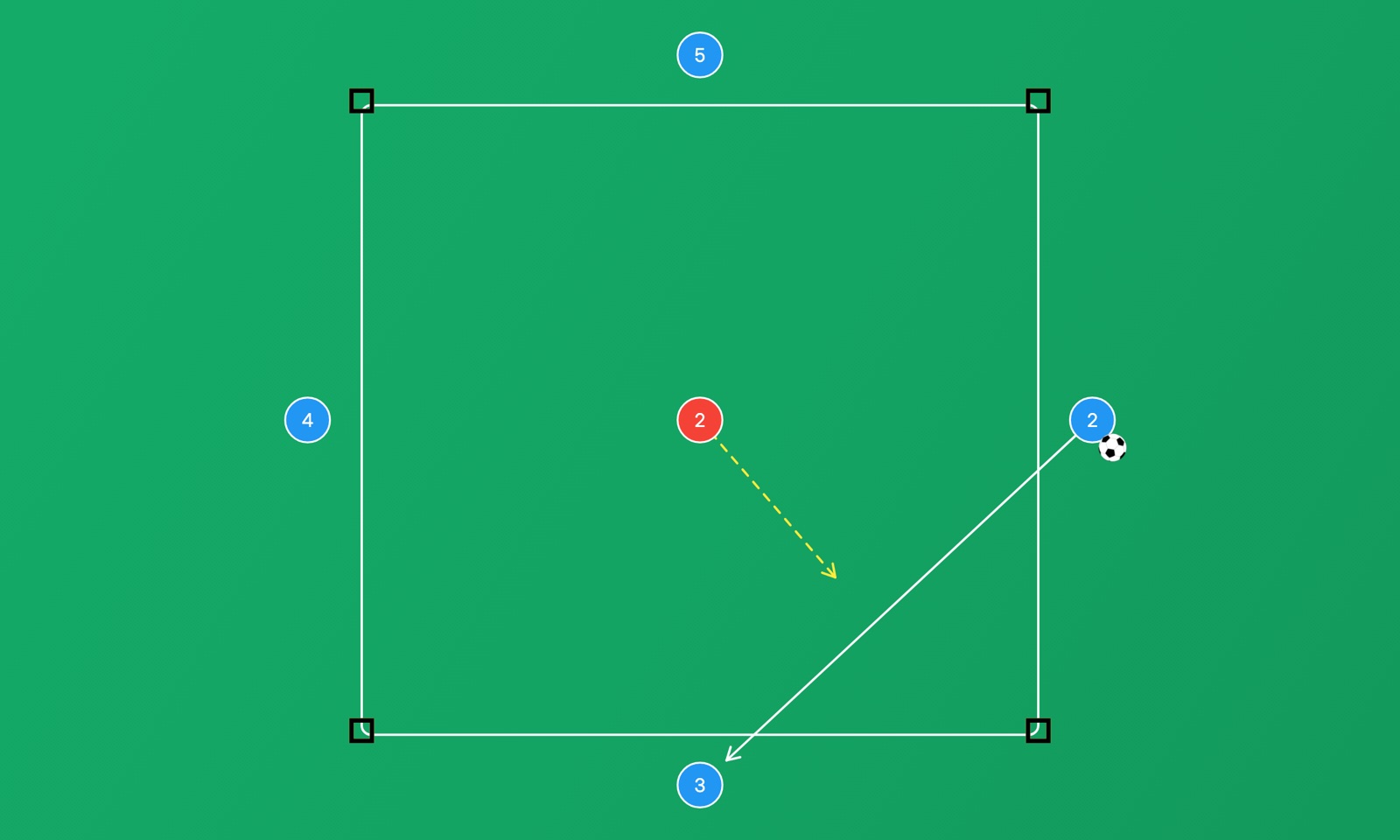
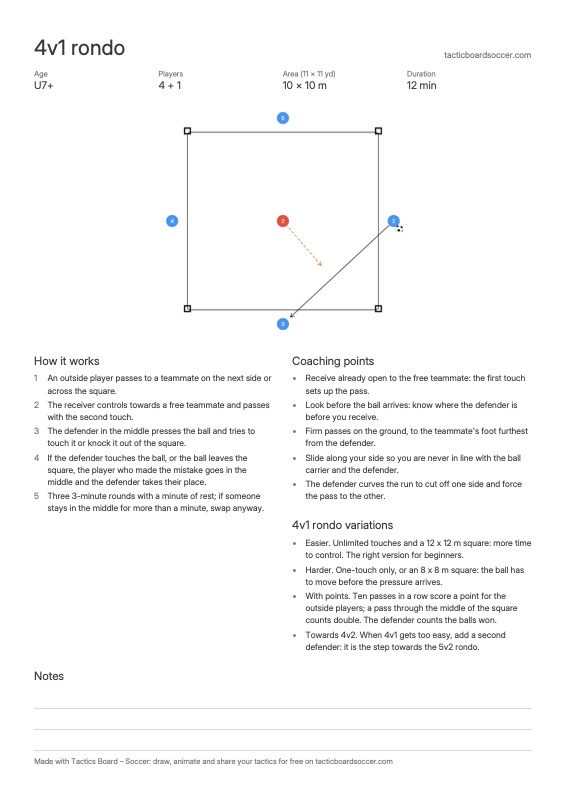
4v1 rondo on a soccer tactics board: four blue players on the sides of a square of cones, one red defender in the middle, the pass arrow and the defender's run
The 4v1 rondo on the board: blue on the sides, red in the middle. The white arrow is the pass, the yellow one the defender's pressing run.

What the 4v1 rondo trains

With four against one, the player on the ball always has at least two free teammates. You don't win a rondo by running, you win it by receiving well and passing early. Every player touches the ball dozens of times in a few minutes, far more than in a scrimmage.

It trains the short ground pass, a first touch that takes the ball towards the free teammate, scanning before you receive and, for the player in the middle, pressing that cuts off a passing lane. That is why it works as a warm-up with the ball: in 10 to 12 minutes the team is warm and already thinking about the game.

How to set it up

You need a 10 x 10 meter square (about 11 x 11 yards) marked by four cones, one ball and a pinnie for the player in the middle. With more players, set up several squares side by side so nobody waits in line: with 15 players, three rondos.

The four outside players stand one on each side of the square and can slide along their side but not step inside. The defender starts in the middle. Play two-touch: one to control, one to pass.

How it works

  1. An outside player passes to a teammate on the next side or across the square.
  2. The receiver controls towards a free teammate and passes with the second touch.
  3. The defender in the middle presses the ball and tries to touch it or knock it out of the square.
  4. If the defender touches the ball, or the ball leaves the square, the player who made the mistake goes in the middle and the defender takes their place.
  5. Three 3-minute rounds with a minute of rest; if someone stays in the middle for more than a minute, swap anyway.

Coaching points

  • Receive already open to the free teammate: the first touch sets up the pass.
  • Look before the ball arrives: know where the defender is before you receive.
  • Firm passes on the ground, to the teammate's foot furthest from the defender.
  • Slide along your side so you are never in line with the ball carrier and the defender.
  • The defender curves the run to cut off one side and force the pass to the other.

Questions to ask your players

  • Before you received, did you see where the defender was coming from?
  • Where did your first touch take the ball, and why?
  • When the defender blocks one teammate, who can you still pass to?
  • Defender: which way do you run to leave only one pass open?
4v1 rondo variations

Change one rule at a time, when the team strings ten passes together easily or when the defender never wins the ball.

Easier

Unlimited touches and a 12 x 12 m square: more time to control. The right version for beginners.

Harder

One-touch only, or an 8 x 8 m square: the ball has to move before the pressure arrives.

With points

Ten passes in a row score a point for the outside players; a pass through the middle of the square counts double. The defender counts the balls won.

Towards 4v2

When 4v1 gets too easy, add a second defender: it is the step towards the 5v2 rondo.

The 4v1 rondo by age group

The same drill works from the youngest players to the first team: the space, the touches and how much you coach technique change.

U7-U8

12 x 12 m, unlimited touches and a coach or the strongest player pressing gently in the middle. What matters is that they pass, not how many passes.

U9-U10

10 x 10 m and three touches, then two. Start asking them to receive open to the free teammate.

U11-U12

Fixed two-touch and rounds with points. Coach scanning before receiving: this is the age to make it a habit.

U13 to adults

One-touch or an 8 x 8 m square, high tempo and quick swaps. For them it is the warm-up, not the main drill.

The printable 4v1 rondo drill sheet

The printable 4v1 rondo drill sheet

One A4 page with the diagram, how it works, the coaching points and the variations, plus lines for your notes. Free, no sign-up: print it for the field or send it to your staff.

Download the PDF (A4)

4v1 rondo FAQ

How big should a 4v1 rondo square be?

Usually 10 x 10 meters, about 11 x 11 yards. Make it 12 x 12 for young players or beginners and shrink it to 8 x 8 for older players and adults to take time away.

How many touches in a rondo?

Two-touch is the most common rule: one to control, one to pass. Unlimited touches for the youngest, one-touch to make it harder.

Why is it called a rondo?

From the Spanish word for a circle: the players stand around the defender. The numbers say how many are outside and how many in the middle, so 4v1, 5v2 and so on. In some countries it is called piggy in the middle or toro.

How long should a 4v1 rondo last?

10 to 12 minutes as a warm-up, in rounds of 2 to 3 minutes. A defender left in the middle too long gets tired and stops pressing, so swap after a minute.

★ 4.8 on Google Play · 500,000+ installs

Draw your own rondo and send it to the team

Open the 4v1 rondo on the board, change the space or the players and save it as yours. Free to start, no account needed.