
The 7v7 formations at a glance
Every 7v7 formation splits the same six outfield players. The numbers read from the back: a 2-3-1 has two defenders, three midfielders and one striker. These are the shapes you meet most often on youth pitches and in 7-a-side leagues.
| Formation | Shape | Pick it when |
|---|---|---|
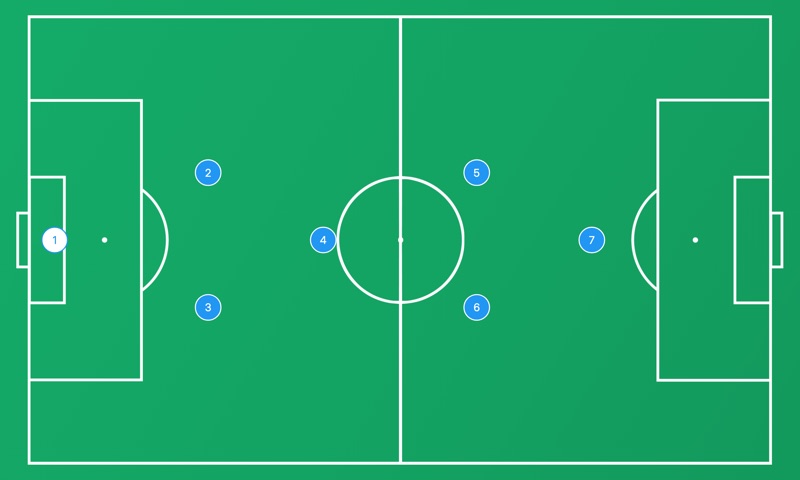
| 2-3-1 | Two defenders, three midfielders on one line, one striker | You want balance and the simplest shape to teach. The most common 7v7 formation. |
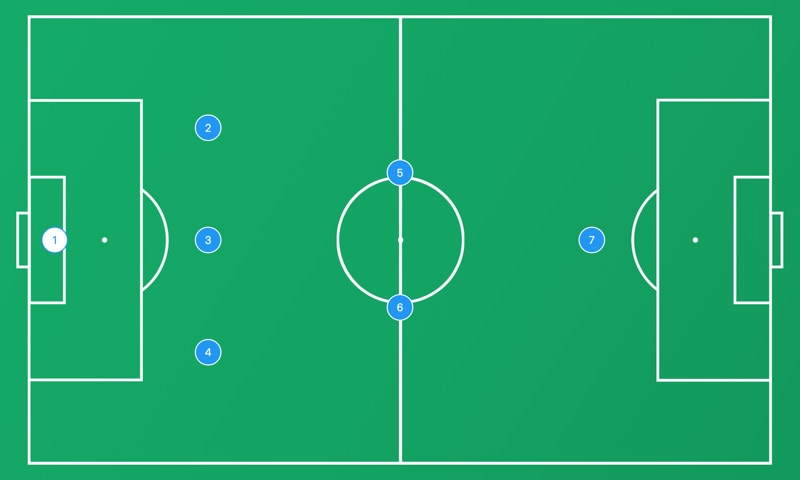
| 3-2-1 | Three defenders, two central midfielders, one striker | Your team concedes too much or your goalkeeper needs safe passes to build from the back. |
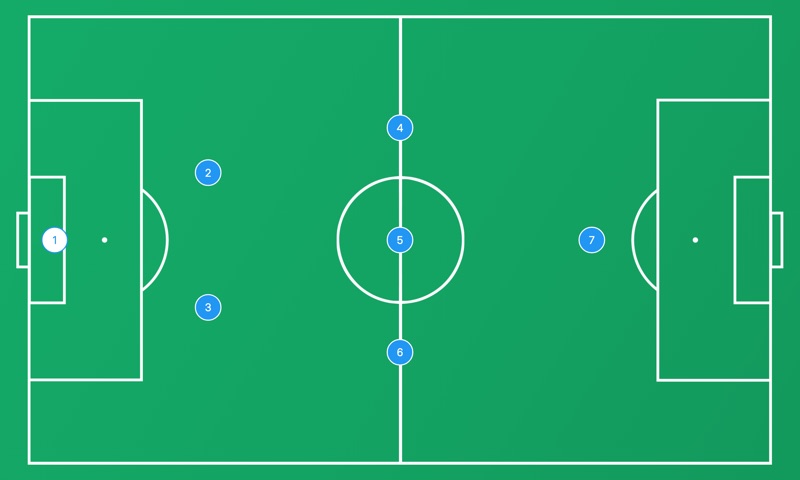
| 2-1-2-1 | Two defenders, a holding midfielder, two wide midfielders, one striker: a diamond | Your players pass well and you want three of them close to goal when you attack. |
| 3-1-2 | Three defenders, a holding midfielder, two strikers | You face a lone striker and want two forwards to press and score. |
| 2-2-2 | Three pairs: defence, midfield and attack | You want every player to have a partner. Simple, but it leaves the middle open. |
| 1-4-1 | One defender, four midfielders, one striker | You want to keep the ball and your players can cover for each other. Risky with young teams. |
The board also has the 2-1-3, the 4-1-1 and the 1-1-3-1. Most of them are not starting shapes but what the others become during the game: a 2-3-1 attacks as a 2-1-3 and defends as a 4-1-1.
2-3-1, 3-2-1 or 2-1-2-1?
The three formations most 7v7 teams choose from use the same idea, with the players in different places.
- The 2-3-1 puts the weight in midfield. The two wide players defend and attack the whole flank, so it needs players who run. In return it has three passing options in the middle and width in attack.
- The 3-2-1 takes one player from midfield and puts them at the back. The back three always has a spare player against one or two strikers, and the goalkeeper can always find a free defender. With the ball the outside defenders step up and the team attacks as a 1-4-1.
- The 2-1-2-1 has the players of the 2-3-1 arranged in a diamond: the central midfielder drops deeper and the wide players push higher. It attacks with three players near the box, but the wide midfielders must run back as soon as the ball is lost.
A simple way to decide: if you concede too many goals, go to three at the back; if your striker is always alone, push the wide players higher; if your team loses the middle, keep three midfielders on one line.
Which 7v7 formation for U9 and U10
In the United States and in England 7v7 is the format of U9 and U10 players, before 9v9 at U11 and U12. At that age the formation matters less than two habits: keeping the width and having a teammate behind the ball.
- First season: a 2-3-1 or a 3-2-1. Three clear lines, and every player knows who is in front and who is behind.
- Second season: the 2-1-2-1 diamond, or the 3-2-1 with the outside defenders stepping up when the team has the ball, so the players learn that a formation moves.
- Always: rotate the players through the positions, goalkeeper included. A player who has defended knows what the defender needs when they play in midfield.
Avoid shapes with a single defender, like the 1-4-1, with young teams: one mistake and the opponent is through on goal.
Formations for adult 7-a-side football
In 7-a-side leagues between adults the pitch is small and the substitutions are often rolling, so the team can press high and run more. The 2-3-1 and the 3-2-1 remain the most common choices; teams with a good passer in front of the defence often play a 3-1-2 with two strikers. Whatever the shape, agree on who drops back when a full-back or a wide player has gone forward: in 7-a-side one missing player means two against one at the back.
From 7v7 to 9v9 and 11v11
A good 7v7 formation already contains the next one. The 2-3-1 becomes the 3-2-3 of 9v9 by adding a defender and a forward, and the 4-3-3 of 11v11 with a back four and two wingers. The 3-2-1 grows into a 3-4-3, the 2-1-2-1 diamond into a 3-1-3-1 in 9v9 and a 4-4-2 diamond in 11v11. Pick your 7v7 formation thinking about how your club plays at the older ages, and the step up will be easier.
To plan your line-up, put the names in the formation builder, or open the tactics board, set seven players per team and choose Formations.